Migas explained: what the small salted-fillet pieces are and who buys them
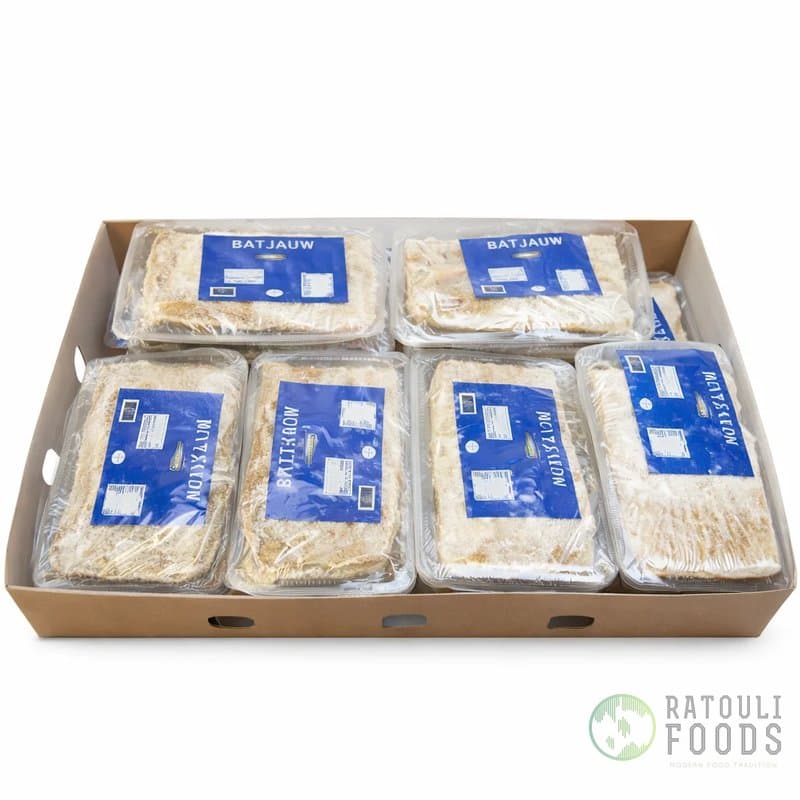
Migas is salted white-fish pieces. The small, boneless, skinless offcuts (faces, wings, tails, thin loins) shredded down from the fillet. It is the cheapest salted-fish format, usually salted pollock processed in China, and it sells to Portuguese, Brazilian, African and Dutch buyers who cook it flaked rather than plated whole.
What migas actually is
Migas is the bits format. A fillet of salted white fish gets trimmed and graded, and from there it splits two ways. The prime loin goes to the premium line. The faces, the wings, the tails and the thin parts of the loin get collected, salted and packed as migas. Boneless, skinless, small. You are buying flavor and yield, not a plate.
The name comes straight off the Portuguese trade. Bacalhau migas means the crumbs or bits of the salt fish, and the word has stuck across the whole salted-fish world. In our Surinaamse-Dutch trade the parent product is Bakkeljauw, also spelled batjauw, which is salted (and traditionally dried) white fish. Migas is one of its formats. It sits below filet and below split-on-the-bone heel and moten on price.
Here is the part most catalogues get wrong, so I will say it plainly. Diaspora-trade Bakkeljauw, the migas included, is usually not classic cod (Gadus morhua). It is salted pollock, what the Dutch call koolvis (Pollachius virens), known in the US as Atlantic pollock and in the UK as coley or coalfish. Since the Grand Banks cod stocks collapsed, most affordable saltfish anywhere is pollock, haddock, blue whiting, ling or tusk. Albert Heijn even labels its retail product as Alaska pollock. I put the species on the spec sheet because honest naming is worth more to a serious buyer than a flattering label.
One trap to avoid. Pollachius virens is saithe or coley, which is the Bakkeljauw fish. Pollachius pollachius is a different animal, the pollack or lythe. If a supplier is loose with that distinction, check the rest of their spec too.
How migas differs from filet and split
Three formats, three price points, three jobs in the kitchen. Pick by what the cook is going to do with the fish.
| Format | Bones / skin | Prep for the cook | Relative price |
|---|---|---|---|
| Filet | Near-boneless, skinless | Desalt, ready to flake | Highest, mass-retail default |
| Split on the bone (heel / moten) | Backbone in, skin on | Desalt, then shred and debone | Cheapest per kilo, most labour |
| Migas | Boneless, skinless, small pieces | Desalt, already flaked | Economical, low labour |
In Codex STAN 167 terms, a split product keeps the whole backbone while a fillet removes the fins and main bones. Migas starts from the fillet side, so the bones and skin are already gone. That is the whole pitch. A kitchen running broodje bakkeljauw, heri heri or bakkeljauwballetjes flakes the fish anyway, so paying for a whole loin and then shredding it down is wasted money. Migas gives them the same shredded result with the deboning already done in the plant.
The trade-off is appearance. You cannot plate migas as a clean fillet portion, and the piece size varies. For any dish where the fish gets stewed, balled, mixed into rice or stuffed into a bun, none of that matters. For a fillet on a plate, buy filet. Match the format to the dish and nobody overpays.
Where it gets processed
Almost all of the world's salted pollock and cod fillet, plus the migas and bits that come off it, gets processed in China. Qingdao and the wider Shandong region is the dominant hub. Raw fish is salted, graded, the prime fillet packed for the premium lines, and the smaller pieces sorted into migas. That concentration is why migas wholesale prices move with Chinese processing capacity and freight, not with the local catch.
Moisture gets cut to the destination market, because every market has its own taste for how wet or dry the salt fish should be. Salt sits around 20 to 22 percent across the board. Moisture is the variable:
- Portugal: 48 to 50 percent moisture
- Netherlands and Spain: 51 percent
- UK: 51 percent
- Brazil: 54 percent
- US: 52 to 54 percent
The control that matters for safety is water-phase salt, WPS, calculated as percent salt times 100 divided by (percent salt plus percent moisture). At 17 percent WPS or higher the product can technically sit ambient. Below that it needs chilled. In practice, heavily salted Bakkeljauw still ships and stores chilled, not ambient, and that is how we move it. Do not let a lower-salt, higher-moisture migas travel warm because a spec sheet says it can.
Who buys migas and why
Migas sells to buyers who cook the fish flaked and who count cost per portion. That covers a lot of the salted-fish map.
Portugal and the Lusophone trade. Bacalhau is o fiel amigo, the faithful friend, and the consoada staple on Christmas Eve. Plenty of Portuguese cooking shreds the fish into bacalhau à brás, bolinhos and casseroles, which is exactly where bacalhau migas earns its place. One legal point. Portuguese law reserves the word bacalhau for Gadus morhua, so pollock there is sold as escamudo or tipo bacalhau. Get the labelling right for that market.
Brazil. Large salted-fish consumer, higher target moisture at 54 percent, strong appetite for the bits format in stews and pastry fillings.
Central Africa. Congolese, Congo-Brazzaville and Gabonese kitchens cook salted fish hard. Their flagship is makayabu, which is its own SKU and which I keep distinct from Bakkeljauw, but the salt-fish-bits demand is real and steady.
Netherlands. Home market for us. About 365,000 people of Surinamese descent, the largest Caribbean community in Europe, roughly 37 percent of all Surinamese worldwide, with Almere holding the highest share. They cook broodje bakkeljauw, heri heri, telo and moksi alesi, all flaked-fish dishes. On July 1, Keti Koti, Free Heri Heri alone hands out over 10,000 portions across Amsterdam. Migas feeds that volume at a sane cost.
Across all of these the common thread is simple. If the fish ends up shredded in the pot, salt fish bits are the smart buy.
Buying it: packs, MOQ and import
Pack norms are settled, so you can plan around them. Retail goes in a 350 to 600 g pouch. Horeca takes a 5 kg bag or a 2x5 kg (10 kg) box. At scale it is 9 kg and 25 kg cartons, and full containers run 20 foot and 40 foot FCL with a minimum order around 10 metric tons.
For EU import there are non-negotiables. You source from an approved establishment, the goods enter through a designated border control post, they travel with a GGB or CHED health document, and you are registered with the NVWA. Skip any of that and the container does not clear. This is also why a verified supply chain beats a cheap quote that cannot show its paperwork.
Two quick boundaries before you order, because mixing them up costs money:
- Bakkeljauw is not stokvis. Stokvis (stockfish, stoccafisso, okporoko, panla) is unsalted, air-dried fish. Bakkeljauw, migas included, is salted. The loose label Surinaamse stokvis for Bakkeljauw is just wrong.
- Migas is not makayabu. Makayabu is salted saithe or pollock split with the backbone in and usually unwashed with heavy surface salt. We sell it as its own line. Migas is the boneless, skinless, shredded format.
Tell me the destination market, the moisture spec you want and your pack size, and I will quote salted pollock migas to match. I trade fish out of Volendam, and I would rather sell you the right format once than the wrong one twice.
Talk volume and price
Book a 15-minute call or send your spec. You deal with the production planner direct, not a call centre.