How fish gets salted: split, dry-salting, water-phase salt and why bakkeljauw ships chilled
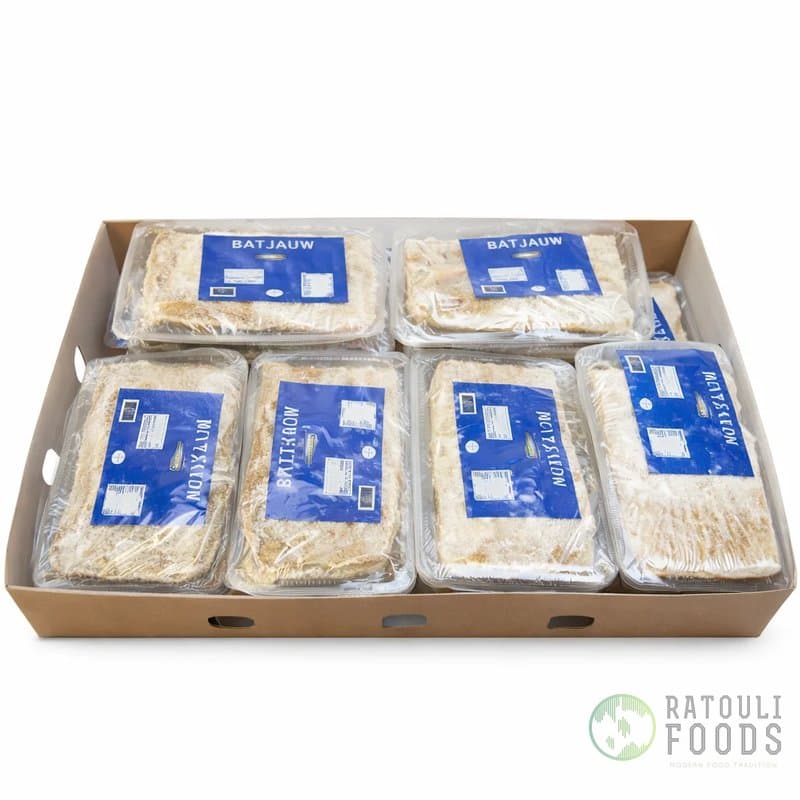
Salt fish starts by splitting the fish open, packing it in dry salt to pull the water out, then grading it by how much salt sits in the water that is left. Water-phase salt is the number that matters. 17 percent or higher allows ambient storage. Anything lower needs chilled. Bakkeljauw ships chilled.
Split, then salt: how the fish actually gets processed
Salting starts at the cutting line, not the salt bin. The fish gets bled, gutted and split. In Codex STAN 167 terms, a split fish keeps the whole backbone in place. A fillet has the fins and the main bones taken out. That one cut sets the product form. Split-and-salted on the bone becomes your cheaper heel (whole) and moten (chunks). A salted fillet becomes the near-boneless retail default that carries a higher price.
Once split, the fish meets salt. Dry-salting is the old method and still the standard one. You layer the split fish skin-down, pack it in coarse salt, stack it, and leave it to cure. The salt pulls water out of the flesh by osmosis while salt diffuses back in. The brine runs off and gets drained. Over days the fish loses weight, firms up, and the salt works deep enough to hold it stable for a long time. That is why bakkeljauw historically kept for up to a year, which is exactly what the long colonial voyages to Suriname needed.
Modern salt fish processing is a graded operation, not a folk craft. The dominant hub is China, around Qingdao in Shandong province. Split and filleted white fish gets salted there, sorted into filet, moten and migas (the small shredded boneless skinless pieces cut from faces, wings, tails and thin loins), then packed for export. The fish is cut to a target moisture and a target salt level, because both numbers are what the buyer is really paying for.
What the species actually is
Before the numbers, name the fish honestly, because most of the trade does not. Bakkeljauw means salted, traditionally also dried, white fish. The word comes down from Portuguese bacalhau. In standard Dutch it is klipvis (rotsvis). Most recipe blogs still write gezouten kabeljauw, salted cod, and most of the time that is simply wrong.
Classic klipvis can be cod, Gadus morhua. The diaspora-trade product usually is not. Since the Grand Banks cod collapse, saltfish almost everywhere is a cheaper species. Saithe (Dutch koolvis, Pollachius virens, sold in the UK as coley or coalfish and in the US as Atlantic pollock), plus ling (leng) and tusk (lom). The Dutch encyclopedia says it plainly. In Suriname, the Antilles and Central Africa, cheaper species stand in for cod. Albert Heijn even labels its product Lufo Bakkeljauw filet Alaska pollock. We name the species on the spec sheet because honesty about what is in the bag is the whole point of dealing with a real trader.
One trap to avoid. Pollachius virens is saithe, coley, the bakkeljauw fish. Pollachius pollachius is a different animal, the pollack or lythe. They are not interchangeable, and a buyer reading a spec should know which one is on offer.
Water-phase salt: the number that runs the HACCP plan
Total salt percentage on a label tells you almost nothing on its own. What controls whether the product is microbiologically stable is how concentrated the salt is in the water still left in the flesh. That is water-phase salt, WPS, and it is the control point your QA team should be checking.
The formula is simple.
| Term | Meaning |
|---|---|
| WPS | Water-phase salt, percent |
| Formula | WPS = %salt x 100 / (%salt + %moisture) |
| Ambient threshold | At least 17 percent WPS |
| Below threshold | Chilled storage required |
Run it with typical bakkeljauw numbers. Salt around 20 to 22 percent, moisture cut to the destination market. Take salt at 21 percent and moisture at 51 percent, the NL and Spain target. WPS = 21 x 100 / (21 + 51) = 2100 / 72 = 29 percent. That sits well above the 17 percent line.
So if the fish carries 29 percent WPS, why not just put it on an ambient shelf? Because WPS sets the floor for safety, not the whole story. Moisture targets vary by destination, and the formula moves with them. Portugal runs 48 to 50 percent moisture, NL, Spain and UK 51 percent, the US 52 to 54 percent, Brazil 54 percent. Push moisture to 54 at the same 21 percent salt and WPS drops to 21 x 100 / 75 = 28 percent, still high. Drop the salt and raise the moisture, the way a lightly salted convenience fillet does, and you can cross under 17 percent fast. That is the point where chilled stops being optional.
Why bakkeljauw still ships and stores chilled
Here is the answer to the question buyers ask most. Why is bakkeljauw chilled if it is that salty. Two reasons, and they stack on top of each other.
- Quality, not just safety. WPS controls bacterial growth, but it does not stop everything. Heavily salted fish kept warm oxidizes over time. It can develop pink halophilic discoloration and rancid fat. Chilled holding keeps the fillet white, firm and clean-smelling all the way through the chain, which is what a retail or horeca buyer is paying for.
- The convenience trend. Modern retail bakkeljauw is salted less aggressively than the year-keeping product of the past, because nobody wants to spend a day desalting it. Lower salt and higher moisture pull the effective WPS down toward the line. Once you are near or under 17 percent, chilled is the rule, not a courtesy.
So the trade convention is straightforward. Heavily salted bakkeljauw still ships and stores chilled, not ambient. We move it cold, we hold it cold, and the spec sheet says so. A supplier who offers you ambient bakkeljauw on a pallet is either running a very different salt level than the diaspora market expects, or cutting a corner you will taste later.
Note the family this product sits in, because the rules are not the same across it. Stockfish (stokvis, Stockfisch) is unsalted air-dried fish, never a bakkeljauw synonym, and it stores dry. Makayabu is the same split salted saithe or pollock with the backbone in, usually heavy surface salt and unwashed, sold as its own SKU. Calling bakkeljauw Surinaamse stokvis is wrong, because bakkeljauw is salted klipvis, not unsalted stokvis. Different process, different storage.
What this means for your spec sheet and your shelf
If you buy salt fish for retail or horeca, pin these down before a PO goes out.
- Species, named. Saithe (Pollachius virens), pollock, ling or tusk. Not a vague kabeljauw. Get it on the spec.
- Salt and moisture, with the WPS calculated. Salt 20 to 22 percent, moisture to your market (51 percent for NL). Run the WPS yourself: %salt x 100 / (%salt + %moisture). Confirm it clears 17 percent if you are even thinking about ambient, and assume chilled regardless for bakkeljauw.
- Form. Filet (near-boneless, retail default), heel and moten (on the bone, cheaper, the cook shreds and debones), or migas (small boneless skinless pieces, the economical format).
- Pack and cold chain. 350 to 600 g retail pouch, 5 kg bag, 2x5 kg (10 kg) box for horeca, 9 and 25 kg cartons, 20 foot and 40 foot FCL at container scale with an MOQ around 10 metric tons. All of it chilled.
- Import paperwork. EU entry needs approved-establishment sourcing, a designated border control post, a GGB/CHED health document and NVWA registration. No shortcuts here.
That is the whole job in one line. Split the fish, salt it to a known number, calculate the water-phase salt, keep it cold. The market is real and steady. The Netherlands alone has about 365,000 people of Surinamese descent, the largest Caribbean community in Europe, plus adjacent salt-fish buyers across the Caribbean, the Lusophone world and Central Africa. They know what good bakkeljauw tastes like. Sell them honest fish on the right cold chain and you keep them.
Talk volume and price
Book a 15-minute call or send your spec. You deal with the production planner direct, not a call centre.