Bakkeljauw, makayabu and stockfish: three products, three buyers
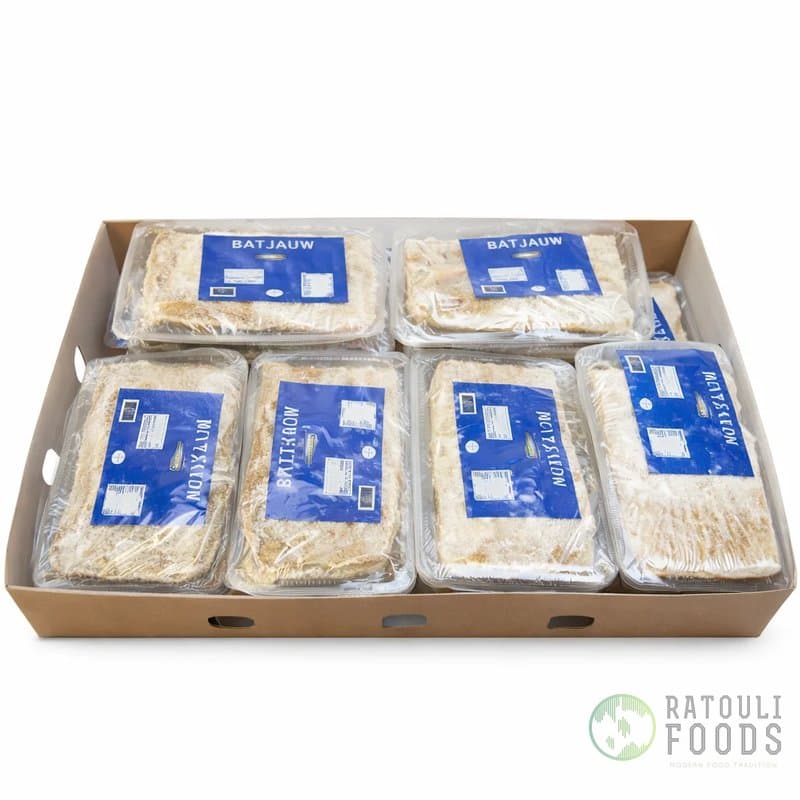
Bakkeljauw is salted saithe or pollock for the Surinamese and Caribbean trade. Makayabu is the same salted saithe or pollock, split on the bone with heavy surface salt, eaten across Central Africa. Stockfish is unsalted air-dried fish for the West African market. Same shelf, three buyers, three products. Do not treat them as one.
Three products that get lumped together, and why that costs you
I have moved salted and dried fish through Volendam for 14 years. The most common mistake I see from an importer building a new range is treating bakkeljauw, makayabu and stockfish as one category with three names. They are not. They share a shelf and the same preservation logic, but they are processed differently, salted differently, and bought by different communities that will not accept a swap.
Here is the short version before I get into detail. Bakkeljauw is salted white fish, usually saithe or pollock, sold to Surinamese and Caribbean buyers. Makayabu is the same salted saithe or pollock, split on the bone with heavy surface salt, a Central African staple. Stockfish is unsalted and air-dried, and it is never a synonym for the other two. Confuse stockfish with bakkeljauw and you have promised an unsalted product and shipped a salted one. Your buyer knows on the first taste.
Why this matters in money terms: each product has its own moisture target, salt level, pack format and cold-chain rule. Get the spec wrong and you either fail an NVWA check or lose the customer. So let me walk through each one the way I would over coffee with a buyer.
Bakkeljauw: salted saithe, not cod, and the species truth that sells it
Bakkeljauw is the Surinamese word for what standard Dutch calls klipvis or rotsvis. The name comes from the Portuguese bacalhau, through the Spanish bacalao, and you will see it spelled bakkeljouw, bakkaljauw or batjauw depending on the family. Heavy salting keeps it for up to a year. That is exactly why it suited the long colonial voyages to Suriname in the first place.
Now the part most blogs get wrong. Diaspora-trade bakkeljauw is usually not Gadus morhua, the classic cod. Since the Grand Banks cod collapse, modern saltfish is most often saithe (koolvis, Pollachius virens, sold in the US as Atlantic pollock and in the UK as coley or coalfish), and sometimes ling or tusk. Albert Heijn sells a Lufo bakkeljauw filet that is openly labelled Alaska pollock. Most recipe sites still write gezouten kabeljauw, salted cod, and they are wrong. Honest species naming is an authority lever, not a weakness. Tell the buyer it is saithe and they trust the rest of your spec.
One trap to avoid in your own labelling. Pollachius virens is saithe, the bakkeljauw fish. Pollachius pollachius is a separate species, pollack or lythe. Do not let a supplier swap the name on you.
Product forms matter for your range. Filet, near-boneless and ready after desalting, is the mass-retail default and costs more. Split-and-salted on the bone comes as heel (whole) and moten (chunks), runs cheaper, and forces the cook to shred and debone. Migas is the small shredded boneless-skinless pieces, the economical format, heavily China-processed. In Codex STAN 167 terms, split keeps the whole backbone while fillet removes the fins and main bones.
Every bakkeljauw buyer deals with the same first step: uitkoken, the desalting. The fish is inedibly salty until you do one of two things. Boil it 15 to 20 minutes in plenty of water, drain, taste and repeat. Or soak it about 24 hours, changing the water every 3 to 4 hours. Then rinse cold, squeeze dry, flake and pick out every bone. That single how-to drives more search traffic than any recipe, so it is worth knowing when you talk to retail buyers about pack sizing.
Makayabu and stockfish: the two products you must keep distinct
Makayabu is salted saithe or pollock, split with the backbone still in, and usually unwashed so it carries heavy surface salt. The name traces back to bacalhau and the French morue, both of which mean cod, so the word gets mixed up with cod in conversation, but a carton sold as makayabu is the same white fish as bakkeljauw, cured harder. It is a Central African staple, eaten in DR Congo, Congo and Gabon. We sell it as its own SKU at Ratouli, not as a variant of bakkeljauw, because the buyer wants it that way: heavier salt, on the bone, and a flavour the Congolese kitchen is built around. If you are looking at makayabu wholesale to serve that community, do not try to cover it with a desalted boneless filet. It is a different product for a different table. For the Surinamese-trade form of the same fish, see Bakkeljauw wholesale.
Stockfish is the one that gets mislabelled most. Stockfish, stokvis, Stockfisch, stoccafisso, Igbo okporoko, Yoruba panla, is unsalted air-dried fish. No salt at all. It is dried on racks in cold air until hard, and it serves the West African market, Nigeria above all. You will sometimes see bakkeljauw called Surinaamse stokvis in loose Dutch usage. That label is technically wrong, because bakkeljauw is salted klipvis, not unsalted stokvis. The distinction is not pedantry. An importer who orders stockfish and receives salted fish has a rejected shipment.
So the rule for your range is simple. Bakkeljauw equals salted saithe or pollock for the Surinamese and Caribbean trade. Makayabu equals the same salted saithe or pollock, split on the bone, heavy salt, for Central African buyers. Stockfish equals unsalted air-dried for West African buyers. Three SKUs, never merged on a price list.
The product-to-buyer map
This is the table I keep coming back to when an importer asks me how to structure a salted and dried fish range. It maps each product to the community that actually buys it, the processing reality, and the format you will be selling.
| Product | What it is | Salt | Primary buyer | Typical format |
|---|---|---|---|---|
| Bakkeljauw | Salted saithe or pollock (klipvis), occasionally ling or tusk | Salted, desalt before use (uitkoken) | Surinamese and Caribbean diaspora, mainly Netherlands | Filet, heel and moten on the bone, migas |
| Makayabu | Salted saithe or pollock, split with backbone in, usually unwashed | Heavy surface salt | Central African and Congolese (DR Congo, Congo, Gabon) | Split on the bone, own SKU |
| Stockfish | Unsalted air-dried fish (okporoko, panla) | No salt | West African, Nigeria above all | Whole dried, heads and pieces |
The geography behind bakkeljauw is worth sizing. The Netherlands holds about 365,000 people of Surinamese descent, the largest Caribbean community in Europe and roughly 37 percent of all Surinamese worldwide, with Almere carrying the highest share. Secondary diaspora runs through France and French Guiana, the US, Guyana, Aruba and Canada. Around that core sit other salted-fish buyers. The Caribbean trade, where ackee and saltfish is Jamaica's national dish. The Portuguese and Lusophone market, where bacalhau is the Christmas Eve consoada staple. The Central African makayabu eaters already covered above. One range, several doors.
B2B specs: moisture, salt, packs and the cold-chain rule that trips people up
Now the part that decides whether your shipment clears and sells. China, mainly Qingdao and Shandong, is the dominant processing and export hub for salted pollock and cod filet, migas and bits. Moisture is cut to the destination market: Portugal 48 to 50 percent, Netherlands and Spain 51 percent, UK 51 percent, Brazil 54 percent, US 52 to 54 percent. Salt sits around 20 to 22 percent. Ask your supplier for the moisture spec by market, not a generic number.
Pack norms follow the channel. Retail runs 350 to 600 g pouches. Horeca takes the 5 kg bag and the 2x5 kg, 10 kg, box. At container scale you are into 9 and 25 kg cartons, 20 foot and 40 foot FCL, with a MOQ around 10 metric tons. Plan your first order against the channel you are actually serving, not the cheapest unit price.
The control that catches new importers is water-phase salt. WPS equals percent salt times 100, divided by percent salt plus percent moisture. It is the HACCP control point. At least 17 percent WPS allows ambient storage. Below that, the product needs chilled. And here is the practical catch. Heavily salted bakkeljauw still ships and stores chilled, not ambient, despite the salt. Do not assume salt alone buys you a shelf at room temperature. Spec the cold chain.
On EU import, the basics: approved-establishment sourcing, entry through a designated border control post, a GGB or CHED health document, and NVWA registration. None of that is optional. Get it lined up before the fish moves.
That is the working version of the three products. Bakkeljauw, makayabu and stockfish, built into one coherent salted and dried fish range without blurring what each one is. If you want to talk through specs or a first order for your channel, that is what we do here in Volendam every week.
Talk volume and price
Book a 15-minute call or send your spec. You deal with the production planner direct, not a call centre.