Private label, HACCP and EU import: putting your brand on salted saithe and pollock
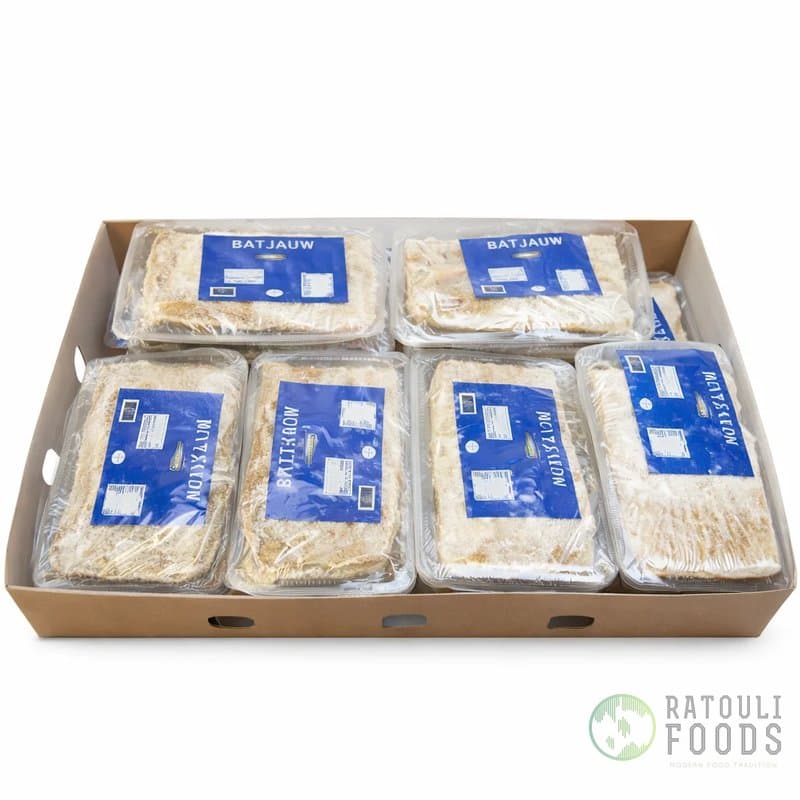
To put your brand on salted saithe or pollock in the EU you need three things in order. Fish from an EU-approved establishment, a clean GGB/CHED health document cleared at a designated border control post, and your own NVWA registration. We handle the import side, then pack private label from one pallet.
Private label from one pallet, not one container
Most buyers who ask me about private label salt fish expect a 10 metric ton minimum and a six-week wait. That is the container model. China-processed salted pollock fillet and migas do move in 20' and 40' FCL with an MOQ around 10 tons, and if you have the turnover for it, that is the cheapest landed price you will ever see. But most toko chains and foodservice buyers cannot shift a full container of one SKU before it ages.
We pack from one pallet. The stock is already landed, already cleared, sitting chilled in Volendam. You pick the format and the pack size, we run your label, you take a pallet. That is the whole reason we hold inventory here instead of drop-shipping from Qingdao.
Standard formats we pack under a buyer's brand:
- Retail pouch, 350 to 600 g, for shelf in a toko or supermarket
- 5 kg bag and 2x5 kg (10 kg) box for horeca and central kitchens
- 9 kg and 25 kg cartons for processors who portion themselves
Format drives price more than brand does. Filet, near-boneless and ready after desalting, is the mass-retail default and costs more. Split-and-salted on the bone, sold heel or in moten, runs cheaper and makes the cook shred and debone. Migas, the small shredded boneless-skinless pieces, is the economical format. Tell me the shelf price you are aiming at and I will tell you which format and moisture spec gets you there.
Know what you are actually buying: the species truth
Before your name goes on a pouch, get the species right. It is the cheapest authority you will ever buy. Diaspora-trade bakkeljauw is usually not Gadus morhua, the classic cod. The honest answer is that most klipvis on this market is saithe (Dutch koolvis, Pollachius virens, sold as coley in the UK and Atlantic pollock in the US), or pollock, or blue whiting, ling or tusk. Albert Heijn already labels its product Alaska pollock. Most recipe blogs still write gezouten kabeljauw, and most of them are wrong.
Watch the pollock trap. Pollachius virens is the saithe that becomes bakkeljauw. Pollachius pollachius is a different fish, the pollack or lythe. If a supplier's spec sheet is loose about which one, that tells you something about the rest of their paperwork.
This matters for your label, not just for pride. Portuguese law reserves the word bacalhau for Gadus morhua, so saithe gets sold there as escamudo, tipo bacalhau. Naming the species honestly on your pack keeps you clean across locales and reads as confidence, not apology. When I quote you, the spec says exactly what the fish is.
The EU import chain: approved establishments, border control posts, GGB/CHED
Salted fish is a product of animal origin, so EU import runs through veterinary controls. The chain has four fixed points and you cannot skip any of them.
Approved establishment. The fish has to come from a processing plant that holds an EU approval number for its country. China (Qingdao and the wider Shandong region) is the dominant hub for salted pollock and cod fillet, migas and bits, and the serious plants there carry the approval. If a plant is not on the approved list, the consignment does not enter. Full stop.
Designated border control post (BCP). The consignment lands at a BCP approved for fishery products, where documentary, identity and physical checks happen before release.
GGB/CHED. Every consignment travels with a health certificate from the origin country and is pre-notified into the EU system as a CHED, the document the Dutch still call a GGB. This is the spine of the whole import. No clean CHED, no release.
NVWA registration. The importer of record has to be registered with the NVWA. That registration is what lets your business be the named party bringing fish into the Netherlands.
| Step | What it proves | Who holds it at Ratouli |
|---|---|---|
| Approved establishment | The plant meets EU hygiene standards | Origin plant, verified by us before we buy |
| Border control post | The consignment was checked on entry | BCP, on our import |
| GGB/CHED | This exact lot is documented and cleared | Ratouli as importer of record |
| NVWA registration | The importer is a registered EU business | Ratouli |
This is the part most first-time importers underestimate. Get one document wrong and the lot sits at the port running up demurrage. We carry that chain so your brand starts at the pallet, not at the customs broker.
HACCP and water-phase salt: why this fish ships chilled
The control that keeps salt fish safe is not the total salt number. It is water-phase salt. WPS is the salt as a percentage of the water plus salt in the fish: %salt x 100 / (%salt + %moisture). It is the figure your HACCP plan lives or dies on.
The rule of thumb: at or above 17 percent WPS, the product can sit ambient. Below that, it stays chilled. Heavily salted bakkeljauw still ships and stores chilled in our chain. We do not pretend a salted product is shelf-stable just because it is salty. That line is not negotiable.
Moisture is cut to the destination market, and your spec should match where you are selling:
| Market | Moisture | Salt |
|---|---|---|
| Portugal | 48 to 50 percent | around 20 to 22 percent |
| Netherlands, Spain | 51 percent | around 20 to 22 percent |
| UK | 51 percent | around 20 to 22 percent |
| US | 52 to 54 percent | around 20 to 22 percent |
| Brazil | 54 percent | around 20 to 22 percent |
A wetter product eats better and weighs more, which buyers like, but it lowers WPS and pushes you toward chilled storage and shorter life. A drier product holds longer and travels harder. Your spec is a trade between those two. I will quote you both so you choose with the numbers in front of you, not after the first complaint from a store.
How Ratouli runs a private-label build
Here is the order of work when a toko chain, a foodservice group or a first-time brand owner comes to us. It is short on purpose.
- Pick the fish and format. Saithe, pollock or another whitefish, then filet, split on the bone, or migas. Named honestly on the spec.
- Set the spec to your market. Moisture and WPS dialed to where you sell, chilled chain confirmed.
- We import. Approved-establishment sourcing, BCP, GGB/CHED, NVWA registration in our name. You do not touch the customs side.
- We pack your label from one pallet. Pouch, bag, box or carton, your artwork, your brand.
- You sell it. Bakkeljauw for the broodje bakkeljauw and heri heri trade, makayabu as its own SKU for Central African buyers, whatever your shelf needs.
One note on naming for your own catalog. Bakkeljauw is salted saithe or pollock, klipvis. It is not stokvis. Stokvis is unsalted air-dried fish, a different product entirely, and calling salted fish Surinaamse stokvis is wrong even though plenty of people do it. Makayabu is the same salted saithe or pollock, split with the backbone in and usually unwashed, a Central African staple we sell separately. Keep these distinct on your label and your brand stays credible with the buyers who actually know the fish. The full product range shows what we already run.
If you have a target shelf price and a market, that is enough to start. Send me those two and I will come back with formats, specs and a per-pallet price.
Talk volume and price
Book a 15-minute call or send your spec. You deal with the production planner direct, not a call centre.