Salt fish grades and specs: reading a Codex STAN 167 sheet
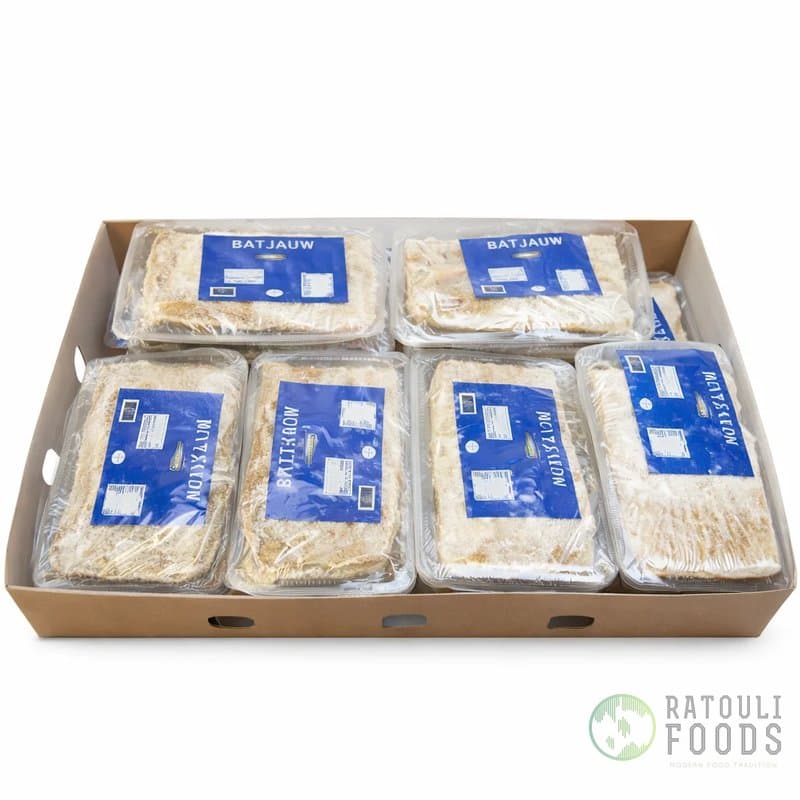
Codex STAN 167 is the international standard for salted fish. It sets the grades, the cut (split keeps the backbone, fillet takes out the main bones), and the moisture and salt limits. A clean spec sheet shows species, cut, grade, moisture, salt, water-phase salt, pack and storage temperature.
What Codex STAN 167 actually covers
Codex STAN 167 is the Codex Alimentarius standard for salted fish and dried salted fish of the Gadidae family. That family is cod, saithe, pollock, ling and tusk, which covers most of what trades as bakkeljauw, bacalhau and makayabu. The standard exists so a buyer in Rotterdam and a processor in Qingdao mean the same fish when they write "salted cod" or "split, salted, dried".
It does three jobs. It defines the product: raw material, salting method, presentation. It sets the quality factors, so moisture and salt ranges, freedom from defects, decomposition limits. And it fixes the labelling so the species and cut on the carton match what is inside the box. When a salted cod sheet cites STAN 167, you are reading against a known frame instead of a supplier's sales pitch.
One thing the standard will not let you do is hide the species. Most diaspora-trade bakkeljauw is not Gadus morhua. It is usually saithe (Pollachius virens, Dutch koolvis, US Atlantic pollock), or pollock, sometimes ling and tusk. Since the Grand Banks cod collapse that has been normal across the whole salted-fish trade. A sheet that names the real species is doing its job. One that just says "cod" when the fish is saithe is not.
Split versus fillet, and the other forms
The cut decides yield, price and how much work lands on the cook. In STAN 167 terms, split keeps the whole backbone in. The fish is opened, the guts and most of the head come out, and the spine stays. Fillet takes out the fins and the main bones, so you get the muscle with little or no skeleton.
On the buyer side that maps cleanly to the formats you will quote on:
- Fillet (near boneless, few or no graten). Ready after desalting, costs more, and it is the mass-retail default. Albert Heijn's Lufo Bakkeljauw filet is Alaska pollock, for example.
- Split-and-salted on the bone. Sold as heel (whole) and moten (chunks). Cheaper, and it forces the cook to shred and debone after the uitkoken step.
- Migas. Small shredded boneless, skinless pieces: faces, wings, tails, thin loins. The economical format, heavily China-processed, good for kitchens that want fish for stews and broodje bakkeljauw without paying fillet money.
Makayabu plays by different rules. It ships split with the backbone in, usually unwashed, so it carries heavy surface salt. Different SKU, different look, and a Central African buyer expects exactly that. Do not quote a washed, low-salt fillet against a makayabu enquiry.
Moisture and salt: the numbers that decide the deal
This is where the arguments start. Moisture is cut to the destination market, because each market eats the fish at a different texture and a different price point. Salt sits around 20 to 22 percent everywhere. Push moisture up and you ship water at fish prices, and the product goes soft. Push it down and the fish gets harder, lighter and dearer per portion. The buyer's job is to fix the target on paper before production starts.
| Market | Moisture target | Salt | Note |
|---|---|---|---|
| Portugal | 48 to 50 percent | ~20 to 22 percent | Driest. Bacalhau is the Christmas Eve consoada staple. |
| Netherlands | 51 percent | ~20 to 22 percent | Surinamese bakkeljauw trade, broodje and heri heri. |
| Spain | 51 percent | ~20 to 22 percent | Bacalao market. |
| United Kingdom | 51 percent | ~20 to 22 percent | Caribbean saltfish demand. |
| United States | 52 to 54 percent | ~20 to 22 percent | Softer, wetter pack. |
| Brazil | 54 percent | ~20 to 22 percent | Wettest of the common targets. |
The control that ties salt and moisture together is water-phase salt. WPS = percent salt x 100 / (percent salt + percent moisture). It tells you the salt concentration in the water that is actually in the fish, which is what stops spoilage. At least 17 percent WPS allows ambient handling under HACCP. Below that the product needs chilled. In practice, heavily salted bakkeljauw still ships and stores chilled rather than ambient, so plan the cold chain regardless. Ask for the WPS figure, not just salt and moisture on their own. Two lots with the same salt percent can sit either side of that 17 percent line depending on moisture.
Reading a spec sheet line by line
A salted cod sheet you can actually act on carries the same fields every time. When one is missing, that is the line to query before anything else. Here is what each field tells a buyer, and what good looks like.
- Species. The real one. Saithe (Pollachius virens), Atlantic pollock, ling or tusk for bakkeljauw. Gadus morhua only if it genuinely is cod. Watch the pollock trap: Pollachius virens is saithe and coley, while Pollachius pollachius is the separate pollack. They are not interchangeable on a contract.
- Cut and presentation. Split, fillet or migas, and whether it is salted only or salted and dried.
- Grade. Codex grading runs on appearance, salting evenness and defect count. Higher grades have fewer bones, cleaner colour and tighter trim. Lower grades carry more blemishes and yellowing, which is fine for shredded stew formats and cheaper per kilo.
- Moisture and salt. Both as percentages, matched to the market from the table above.
- Water-phase salt. The HACCP number. At least 17 percent for ambient, otherwise chilled.
- Storage temperature. Chilled for heavily salted product. If a sheet claims ambient, check the WPS backs it.
- Pack. 350 to 600 g retail pouch, 5 kg bag, 2x5 kg (10 kg) box for horeca, 9 or 25 kg cartons, 20 foot and 40 foot FCL at container scale, MOQ around 10 metric tons.
- Origin and approval. Approved establishment, EU number, processing hub. China (Qingdao, Shandong) is the dominant hub for salted pollock and cod fillet, migas and bits.
Keep one category line straight while you read. Stockfish (stokvis, okporoko, panla) is unsalted air-dried fish and is never a bakkeljauw synonym. If a sheet says "stokvis" but lists 20 percent salt, the label is wrong, not the lab.
Import paperwork and what I check before I buy
Specs get you to a price. Paperwork gets the container released. For EU import the fish has to come from an approved establishment, enter through a designated border control post, travel with a GGB or CHED health document, and the importer needs NVWA registration. None of that is optional. A cheap quote from a non-approved plant is not a saving, it is a stuck container.
What I do before I commit, after 14 years buying fish out of Volendam, is short and boring on purpose. I confirm the species against the Codex family and reject any sheet that says "cod" without proof. I match moisture to the destination market, not to whatever the processor happened to run last. I read the WPS and set the storage temperature off that number, chilled for heavy salt. Then I check the establishment approval and the health document path before I talk price seriously.
That order matters. A beautiful price on the wrong species, the wrong moisture or an unapproved plant costs more than a fair price on a sheet you can defend. If you want our salted fish specs, bakkeljauw and a separate makayabu SKU, ask and I will send the sheet with these fields filled in.
Talk volume and price
Book a 15-minute call or send your spec. You deal with the production planner direct, not a call centre.