Who buys bakkeljauw and saltfish in Europe: Surinamese, Caribbean, Portuguese and African demand
Four communities drive saltfish demand in Europe. The Surinamese base in the Netherlands buys bakkeljauw all year. Caribbean households buy saltfish for ackee. Portuguese and Lusophone buyers want bacalhau and peak hard at Christmas. Central African buyers want makayabu. Each has its own format, price point and calendar.
The Surinamese base: bakkeljauw demand in the Netherlands
Planning a saltfish range for Europe? Start with the Netherlands. About 365,000 people of Surinamese descent live here. That is the largest Caribbean community in Europe, roughly 37 percent of all Surinamese worldwide. Almere has the highest concentration. This is your anchor demand, and it barely moves with the season.
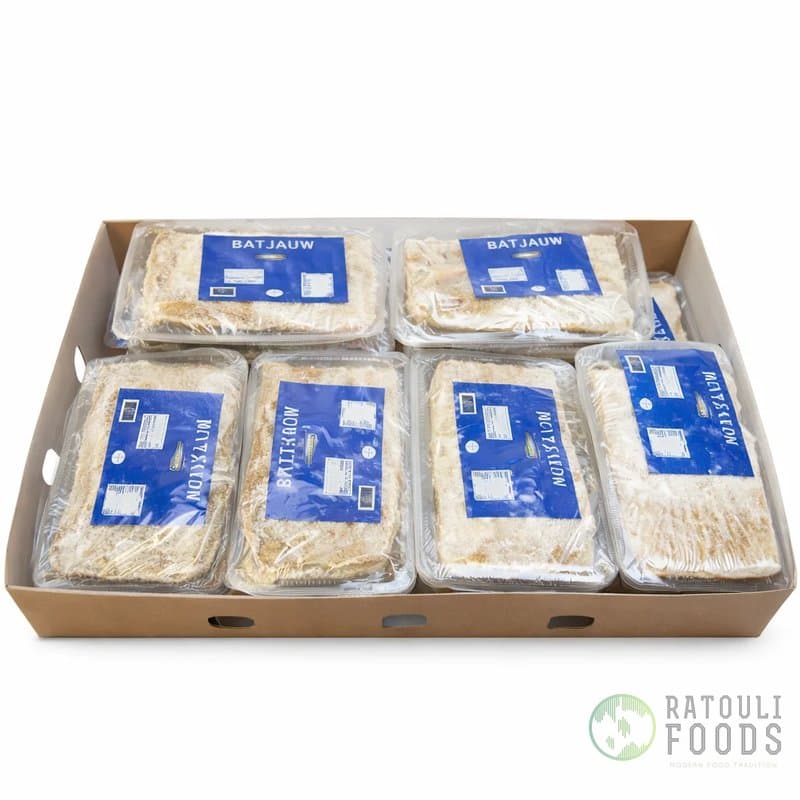
Bakkeljauw is the Surinamese word for salted white fish, what standard Dutch calls klipvis or rotsvis. You will also see it spelled bakkeljouw, bakkaljauw and batjauw. The word comes straight from Portuguese bacalhau, carried over on the colonial voyages to Suriname, where heavy salting kept the fish edible for up to a year.
What pulls volume is the dish list, not the fish itself. Broodje bakkeljauw is the flagship. Desalted flaked fish stewed with onion, garlic, tomato, tomato puree, a Maggi cube and trassi, served on a Surinamese witte puntje with zuurgoed and Madame Jeanette sambal. Telo with bakkeljauw is the Surinamese answer to fish and chips. Heri heri is the plantation-era plate of cassava, sweet potato, plantain, egg and bakkeljauw. Then you have moksi alesi and bakkeljauwballetjes. A buyer needs these names, because a shop owner orders against the dishes, not against a species code.
Format matters here. Filet, near-boneless and ready after desalting, is the mass-retail default and carries the higher price. Split-and-salted on the bone, sold heel or in moten, is cheaper and forces the cook to shred and debone. Migas, the small shredded boneless-skinless bits, is the economical format that moves through busy kitchens and budget households. Stock all three or you lose either the convenience buyer or the price buyer.
The species truth, and why honest naming wins B2B trust
Here is the fact most of the trade gets wrong, and it is worth your attention as a buyer. Diaspora-trade bakkeljauw is usually not Gadus morhua, classic cod. In Suriname, the Antilles and Central Africa the cheaper species have always been used: saithe (Dutch koolvis, Pollachius virens, UK coley or coalfish, US Atlantic pollock), plus ling and tusk. Since the Grand Banks cod collapse, modern saltfish anywhere is often pollock, haddock, blue whiting, ling or tusk. Albert Heijn already sells a Lufo bakkeljauw filet labelled Alaska pollock. Most recipe blogs still write gezouten kabeljauw, which is simply wrong for this product.
Watch the pollock trap. Pollachius virens is the bakkeljauw fish, saithe or coley. Pollachius pollachius is a separate fish, the pollack or lythe. On a spec sheet they are not interchangeable, and a careful buyer should ask which one a supplier means.
Name maps help you order across borders. The Surinamese-Dutch cluster: bakkeljauw, bakkeljouw, bakkaljauw, batjauw, klipvis, rotsvis, bacalao. The generic saltfish names across cultures sit in the table below. For the saithe species itself you will see koolvis (NL), lieu noir or colin (FR), Seelachs or Köhler (DE), carbonero (ES), merluzzo nero (IT), escamudo (PT), coley or coalfish (UK), Atlantic pollock (US).
| Culture | Saltfish term |
|---|---|
| Portugal | bacalhau |
| Spain | bacalao |
| Italy | baccalà |
| France | morue salée |
| Germany | Klippfisch |
| English / Caribbean | saltfish, salt cod |
One legal note that bites in the Lusophone market. Portuguese law reserves the word bacalhau for Gadus morhua. Saithe gets sold as escamudo or tipo bacalhau. Label saithe as bacalhau into Portugal and you have a compliance problem, not a marketing choice. Honest species naming is cleaner, and it is also the authority lever for any serious saltfish supplier.
Caribbean, Lusophone and Central African demand
Beyond the Surinamese base, three more communities buy salted fish, each on its own logic.
Caribbean households are the second pillar. Ackee and saltfish is Jamaica's national dish, and saltfish is the constant in it. These buyers want flaked, well-desalted fish, and they care about the soak more than the species. Wherever you have a Caribbean grocery footprint, the saltfish buyers are there, steady through the year with a lift around Easter and the holidays.
The Portuguese and wider Lusophone market is the big seasonal swing. Bacalhau is called o fiel amigo, the faithful friend, and it is the staple of the Christmas Eve consoada. Demand into Portuguese and Brazilian communities builds from October and spikes in December. If you serve this market the moisture spec is tighter: Portugal runs 48 to 50 percent moisture against 51 percent for NL and Spain. Plan the Christmas volume in summer, because the processing and shipping lead times do not bend in November.
Central African and Congolese buyers want makayabu. This is the same salted saithe or pollock, split with the backbone in, usually unwashed so it carries heavy surface salt. DR Congo, Congo and Gabon households cook it as a staple. Keep it distinct on your SKU list. We sell makayabu as its own line, not as a bakkeljauw substitute, because the cut, the salt level and the customer are all different.
One thing to keep straight so you do not mislabel stock. Stockfish, called stokvis, Stockfisch, stoccafisso or okporoko and panla in West Africa, is unsalted air-dried fish. It is never a synonym for bakkeljauw. The loose Dutch-Surinamese label Surinaamse stokvis for bakkeljauw is technically wrong, because bakkeljauw is salted klipvis, not unsalted stokvis. Mix the two on a price list and you confuse your buyers and your customs paperwork.
Seasonality and range planning
Saltfish demand is not flat across the year, and a good range plan reads the calendar per community.
The Surinamese base buys steadily, with one big tentpole. Keti Koti on July 1 is the emancipation commemoration, and heri heri is its symbol meal. Free Heri Heri alone hands out over 10,000 portions across Amsterdam on that day. Expect a strong June pull on bakkeljauw across Surinamese groceries and caterers, so build that stock in spring.
The Lusophone Christmas is the other major peak, and it is sharper. The consoada drives a December spike that starts building in October. Caribbean demand lifts around Easter and the year-end holidays but stays more even overall. Central African makayabu demand runs steady with no single dominant season.
| Community | Peak window | Driver |
|---|---|---|
| Surinamese (NL) | June into July 1 | Keti Koti, heri heri |
| Lusophone | October to December | Christmas consoada |
| Caribbean | Easter, year-end | Ackee and saltfish |
| Central African | Steady, no sharp peak | Makayabu staple cooking |
For range planning that means three things. Carry filet, on-the-bone and migas so you cover both convenience and price buyers. Keep makayabu as its own SKU for the Central African trade. And phase your purchasing so the December bacalhau and the June bakkeljauw are bought months ahead, because the processing hub does not hold your slot for you.
B2B specs: moisture, salt, packing and EU import
Now the trader detail, the part that decides whether a shipment clears and sells. China, mainly Qingdao and Shandong, is the dominant processing and export hub for salted pollock and cod fillet, migas and bits. Most volume routes through there.
Moisture is cut to the destination market. Portugal sits at 48 to 50 percent, the Netherlands and Spain at 51 percent, the UK at 51 percent, the US at 52 to 54 percent and Brazil at 54 percent. Salt runs around 20 to 22 percent. Get the moisture spec wrong for a market and the product reads as off, even if the fish is fine.
The HACCP control to know is water-phase salt. WPS equals percent salt times 100 divided by the sum of percent salt and percent moisture. At 17 percent WPS or above, the product can hold ambient. Below that it needs chilled. In practice, heavily salted bakkeljauw still ships and stores chilled, not ambient, so plan your cold chain accordingly.
Pack norms run like this:
- Retail pouch: 350 to 600 g
- Horeca: 5 kg bag and 2x5 kg (10 kg) box
- Distribution: 9 kg and 25 kg cartons
- Container scale: 20' and 40' FCL, MOQ around 10 metric tons
For the format spec under Codex STAN 167, split keeps the whole backbone in while fillet removes the fins and main bones. Say which one you want on the order, because the cook experience and the price differ a lot.
On EU import you need approved-establishment sourcing, entry through a designated border control post, a GGB or CHED health document and NVWA registration. None of this is optional, and a buyer who skips the establishment check is buying a problem. We sit in Volendam, we run this paperwork on every line, and a saltfish buyer who wants the species named honestly and the cold chain handled right can call us for a sample and a spec sheet.
Talk volume and price
Book a 15-minute call or send your spec. You deal with the production planner direct, not a call centre.