Buying Bakkeljauw for Your Toko: Whole, Moten or Fillet, and How to Restock
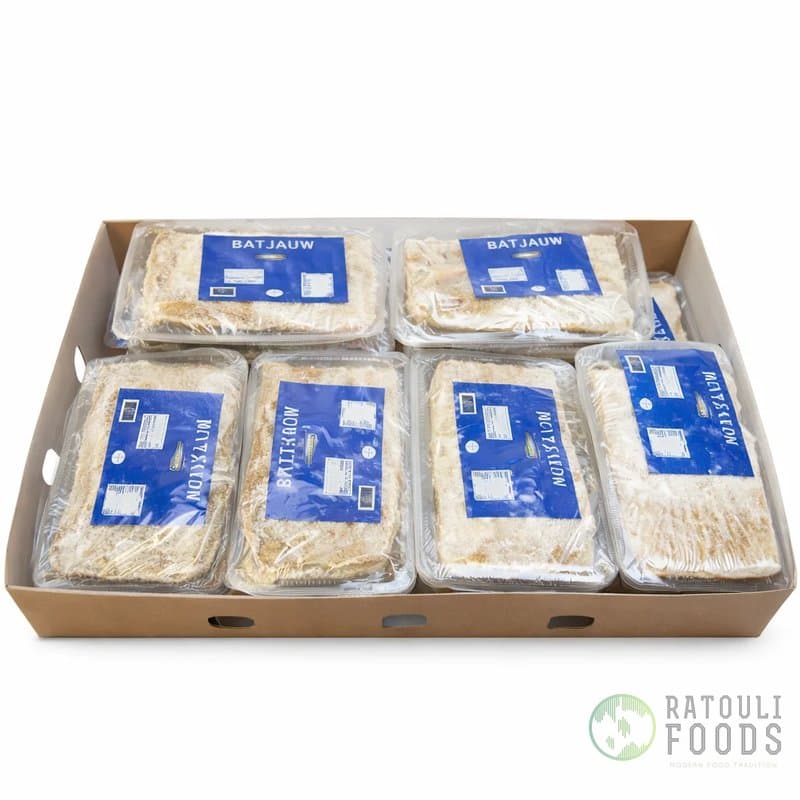
For most tokos Bakkeljauw is the number-one fish, so buy it the way your customers ask for it. Whole for the cooks who want to cut it down themselves. Moten, the pieces, for the everyday buyer. Fillet for the ones who want it ready. Dry salted Bakkeljauw keeps for months in a cool, dry spot, and longer at -18C. Order it in 5kg and 10kg cases, hold two to four weeks of cover, and reorder on a fixed day every week or two. We deliver DAP to your door from an EU-approved plant (NL208262EG), so there is no border paperwork on your side.
Why Bakkeljauw is the toko's first fish to stock
Bakkeljauw is salted, dried fish. In Surinamese and Antillean kitchens it carries the weekend. It goes into heri heri, into roti meals, into bakkeljauw met rijst, and it is on the table at Keti Koti. That pull runs all year, not in a seasonal spike. If you run a Surinamese toko and you only have shelf room for one salted fish, make it this one.
The fish under the name is usually salted saithe or salted pollock, not cod. Both are firm and white-fleshed, and both take salt well. Your customers know it as Bakkeljauw, or Batjauw. The species is a detail you can give if a buyer asks, but it is not how anyone shops for it. We go into saithe versus pollock further down, and in our salted saithe and pollock sourcing guide.
A quick orientation before the buying detail:
- Format: whole, moten (pieces) or fillet. Most tokos carry two of the three.
- State: dry salted and shelf-stable, or frozen at -18C.
- Case sizes: 5kg and 10kg cartons, up to pallet for bigger buyers.
- Delivery: DAP to your door. We handle the transport, you book it in and shelve it.
Whole, moten or fillet: what your customer actually asks for
The format decision is really a customer decision. Stock the cuts your shoppers reach for and the stock turns faster.
| Format | What it is | Who buys it | Notes for the shelf |
|---|---|---|---|
| Whole (heel) | The full salted, dried fish, bone in, skin on | Older and traditional cooks who cut and soak it themselves, and who judge quality by the whole piece | Best value per kilo. Takes more soaking time at home. Looks the part on a counter display. |
| Moten (pieces) | The fish cut into chunks or steaks across the body | The everyday buyer who wants a usable portion without breaking down a whole fish | The fastest mover in most tokos. Easy to grab, easy to price per pack. |
| Fillet | Boneless, skinned salted fillet | Younger and convenience buyers, and people cooking smaller portions | Highest price per kilo, least prep at home. Smaller, more frequent buys. |
For a small Surinamese toko a sensible default is this. Lead with moten as your volume line. Keep whole for the cooks who insist on it. Add fillet once you know your shoppers want it ready. You do not need all three from day one. Watch what sells out first over a month and let that set your mix.
Shelf life, chilled versus frozen
The salt does the preserving. Properly dry salted Bakkeljauw is shelf-stable and does not need the freezer to survive. That is part of why it suits a small shop where freezer space is tight.
| How you hold it | Roughly how long it keeps | When to use it |
|---|---|---|
| Cool, dry, ambient (dry salted) | Several months in a sealed pack, kept out of heat and damp | Your standard for dry salted whole and moten. No freezer needed. |
| Chilled (around 0 to 4C) | Extends an opened or lightly salted product. Days to a few weeks, depending on the pack | For fillet and any lower-salt or moisture-rich packs. |
| Frozen (-18C) | Many months, well past the ambient window | When you buy ahead, or for fillet you want to hold longer. |
Two things to check when a delivery lands. The pack should be dry and intact, and the salt crust even, with no damp patches and no off smell. Store dry packs off the floor and away from heat. If you freeze, keep the cold chain steady and do not let stock thaw and refreeze, because that softens the texture and your customers will notice. And always read the date and storage line on the actual pack. Lower-salt and fillet products behave more like a chilled SKU than a shelf-stable one.
Case sizes and a restock rhythm that keeps the shelf full
We sell to stores in 5kg and 10kg cartons, and up to pallet quantities for wholesalers and shops moving real volume. The 5kg case is the right size to test demand in a small Surinamese toko. The 10kg case is where most steady shops land once Bakkeljauw has proved itself.
A restock rhythm has one job. Never be out of your number-one fish, and never sit on so much that cash and freezer space are locked up. For a typical shop, this works:
- Hold roughly two to four weeks of cover on your volume format, usually moten.
- Place a fixed order on a set day, weekly or every two weeks, so it is routine and not a scramble when the shelf goes empty.
- Reorder against your fastest seller, not your slowest line.
- Keep a small buffer ahead of Keti Koti and family-gathering weekends, when Bakkeljauw demand jumps.
Buying direct from the maker on a fixed cadence saves you the extra margin you pay when you top up at a cash and carry between deliveries. One supplier, one delivery day, a price per kilo you can count on.
Saithe or pollock: the difference for your customer
Most Bakkeljauw is salted saithe (Pollachius virens, also called coley or coalfish) or salted pollock (Pollachius pollachius in Europe; Alaska pollock is a different fish). For the cook, the differences are small.
| Saithe | Pollock | |
|---|---|---|
| Flesh | Slightly darker raw, firms up white once salted and soaked | White, a touch milder |
| Texture salted | Firm, holds together in pieces, good for moten | Firm, flakes a little finer |
| Flavour | Fuller, more savoury | Cleaner, milder |
For a toko buyer the call is simple. Both work for the dishes your customers cook, both salt and soak the same way at home, and grade and salting consistency matter more than which species it is. If a customer asks, tell them it is saithe or pollock, and that it is not cod. The full breakdown, with grades and what to ask a supplier for, is in our salted saithe and pollock sourcing guide.
DAP delivery and how to order
We are an EU-approved plant in Volendam, the Netherlands. Our approval number is NL208262EG and we work to HACCP. For a store buyer that means two things. The product is made under audited food-safety control, and the EU number is on record so you can check the source yourself.
We deliver DAP (Delivered at Place). We bring it to your door and carry the transport. Inside the EU there is no customs friction for you. For shops outside the EU customs zone, DAP means we deliver to the agreed place and the import formalities sit on the receiving side. We tell you plainly what that involves before you order, so nothing catches you out.
To open an account and get pricing:
- Tell us your formats (whole, moten, fillet), whether you want dry salted or frozen, and the case size (5kg, 10kg or pallet).
- Give us your delivery address and roughly how often you expect to reorder.
- We come back with pricing, the minimum order and a delivery day.
If you also stock the rest of the salted-fish family, we can put it on the same delivery. For the wider cross-community range, see buying Surinamese products for your toko on Ratouli Foods. For the consumer side of where Bakkeljauw is sold, see where to buy Bakkeljauw on Surimama.
Talk volume and price
Book a 15-minute call or send your spec. You deal with the production planner direct, not a call centre.