Makayabu (poisson sale) wholesale: cartons for Congolese and West-African stores
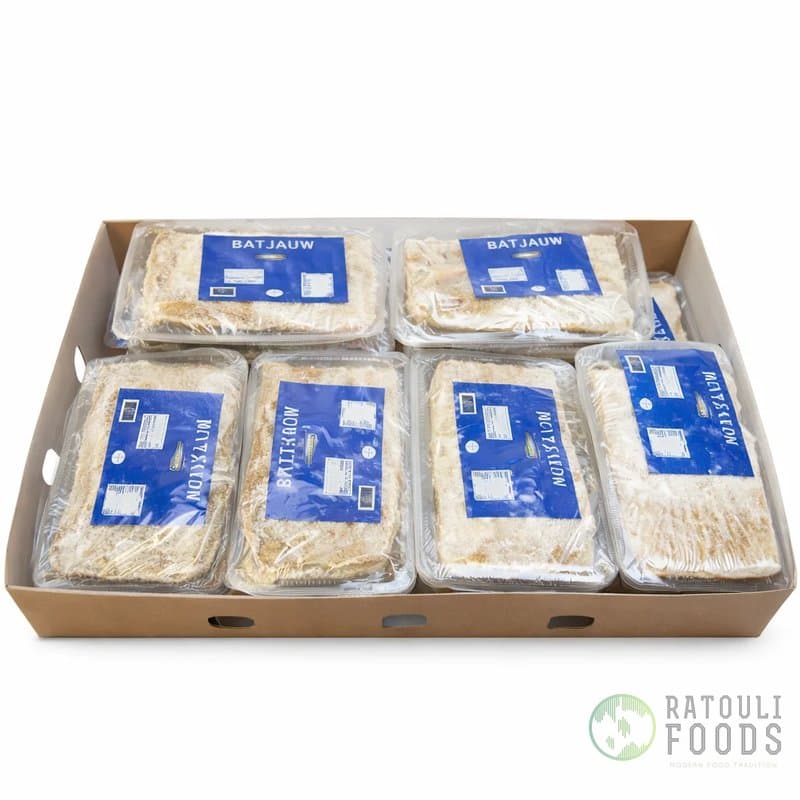
Makayabu is dry-salted whitefish, usually saithe or pollock, sold whole and split. For a shop we pack it in 9-10kg cartons, the same format Congolese and West-African stores in Belgium and France already buy week to week. A realistic first order is around 500kg, and you can mix the cartons across lines. We deliver it DAP to your door from an EU-approved plant, NL208262EG, and samples go out in 5 to 10 days.
Makayabu in cartons for your shop, the short version
Makayabu is salted whitefish. The name comes off the Congolese and Central-African table, and in Belgium and France you will see the same fish written on the shelf as poisson sale. Underneath either label it is dry-salted saithe or pollock, split open and cured hard, so it sits on a shelf without a fridge until your customer carries it home.
In a store the unit that counts is the carton. We pack makayabu whole split in 9-10kg boxes. That is what a shopkeeper stacks in the freezer or the dry store and sells down over a week or two. No container needed to get hold of it. We run an EU-approved plant in Volendam, number NL208262EG, and we deliver DAP, so the box turns up at your address with the cross-border paperwork already off your plate.
- Product: dry-salted saithe or pollock, whole split
- Carton: 9-10kg, the standard store format
- First order: around 500kg, mix the cartons across lines
- Delivery: DAP to Belgium and France, samples in 5 to 10 days
Makayabu, morue, bacalhau: one product, different names
The name shifts with the community. The fish in the box barely does. Here is how the words line up, so you can match what a customer asks for at the counter to what is actually in the carton.
| Name on the shelf | Community / language | What it usually is |
|---|---|---|
| Makayabu | Congolese and Central-African (BE/FR) | Dry-salted saithe or pollock, whole split |
| Poisson sale | French-language shorthand (BE/FR) | Same salted whitefish, generic term |
| Morue | French for cod | Strictly cod, but used loosely for any salt fish |
| Bacalhau salgado | Lusophone-African (Angola, Cape Verde) | Salted cod or salted saithe, Portuguese tradition |
| Bakkeljauw | Surinamese and Antillean (NL) | The same salted saithe or pollock, Dutch market name |
The word makayabu traces back to the Portuguese bacalhau, which is exactly why morue and makayabu get swapped for each other in conversation. One thing to keep straight as a buyer: morue means cod, and cod costs more than saithe or pollock. A carton labelled makayabu is nearly always saithe or pollock cured the same way, not true cod. So if a customer is asking for cod specifically, that is a different fish at a different price. Check before you assume.
Salting grades and species: what to ask for
Two things decide whether a carton turns over in your shop: the species and the cure. Get both right and the box walks out the door. Get them wrong and it sits.
Saithe versus pollock. Both are North Atlantic whitefish and both make good makayabu. Saithe runs darker and firmer with a fuller taste, which is what a lot of Central-African cooks are after. Pollock is paler and milder, nearer to what some Caribbean and Surinamese buyers know as bakkeljauw. One is not better than the other. They are two products, and a shop that knows its regulars can carry both. We supply each on its own, so you are never guessing what landed in the box.
The cure. Dry salting is what gives makayabu its shelf life and its taste. Before you buy a pallet from anyone, ask three things: how hard is the cure, how clean is the salt, and how steady is the moisture from one carton to the next. Cure it too light and it spoils faster and lets the customer down. Cure it unevenly and some boxes are good while others are not. We salt to a fixed level, so the carton you order in March eats the same as the one you order in October.
Format inside the carton. Whole split is the standard, the fish opened flat and salted. Off the same raw material we can run loins or Migas flakes, and vacuum packs for shops that want a tidier shelf or their own label on the front. Tell us how your customers buy and we pack to it.
Cartons, pack sizes and the order ladder
The carton is the working unit, but you can order below pallet level and you can mix lines. Here is the ladder from a single carton up to a full pallet, and where a small shop usually lands.
| Unit | Rough weight | Who it suits |
|---|---|---|
| Carton, whole split | 9-10kg | The shelf unit every store counts in |
| First order, mixed | around 500kg | A small shop or an opening order, cartons mixed across lines |
| Pallet | roughly 500-700kg per pallet | A busy store or a buyer serving several shops |
| Retail pack / vacuum / Migas | per spec | Shops wanting shelf-ready or own-label packs |
Nobody has to fill a pallet on the first go. Around 500kg, mixed across makayabu, bakkeljauw, stockfish and whatever else you stock, is a sensible place to start. That is the reason to buy direct from an EU plant rather than a container importer who wants a full 40ft reefer of one line before he will even take your call.
DAP delivery to Belgium and France
DAP stands for Delivered At Place. We ship the cartons to your address and carry the transport and the cross-border movement. The fish is frozen or salted hard and travels under cold chain, so the cure holds all the way from our plant to your store.
For makayabu the two markets that matter are Belgium and France, where the Congolese and Central-African community sits thickest. Matonge in Brussels is the best-known address. We deliver DAP to both, and across the rest of the EU and the UK as well. Because we are an EU-approved plant, NL208262EG, the box leaves under that approval with HACCP behind it. That is the first thing a serious buyer checks before an opening order.
Lead time on a sample is 5 to 10 days. A sample carton tells you more than any spec sheet ever will. You see the split, feel the cure, and let your own customers taste it before you commit to a pallet. That is how the relationship gets built.
How to order
Give us three things and we can quote: which fish (saithe, pollock, or both), how many cartons or kilos to start, and the delivery address. From there we send a sample, settle the cure and format, and put the first DAP load on the road.
Makayabu is one line in a salted-fish range built for African, Caribbean and Surinamese shops. The same plant runs stockfish, salted herring and the Bakkeljauw family on saithe and pollock, so one supplier and one delivery can cover most of your salt-fish shelf. We are an EU-approved maker selling direct, not a directory listing and not a middleman. That is what keeps the carton price honest and the restock dependable.
Talk volume and price
Book a 15-minute call or send your spec. You deal with the production planner direct, not a call centre.