Salted saithe and pollock for the bakkeljauw and saltfish trade: a buyer's sourcing guide
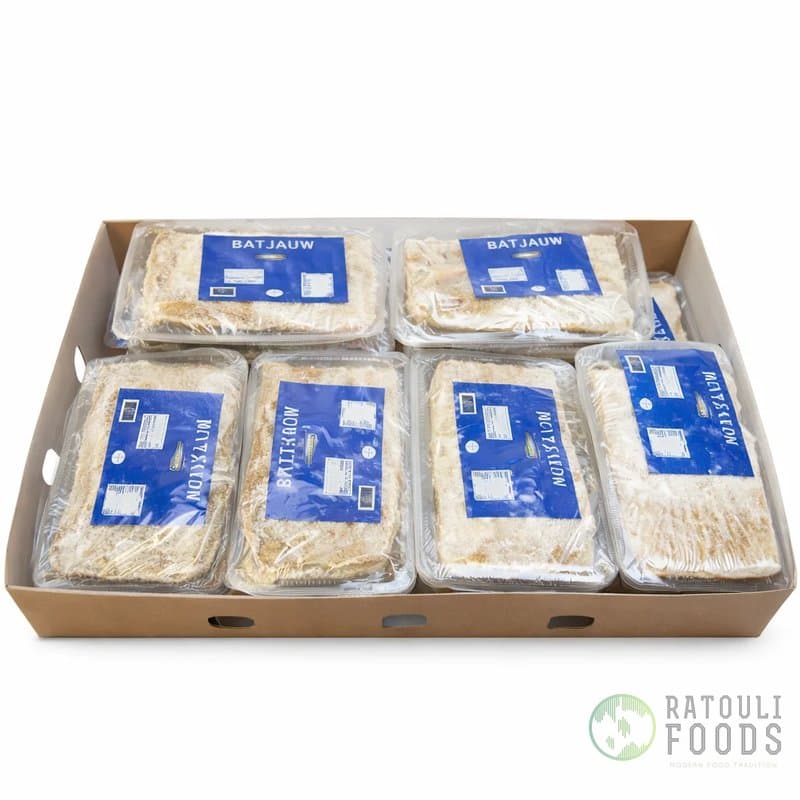
Bakkeljauw is heavily salted white fish, and in the diaspora trade it is usually salted saithe or Alaska pollock, not classic cod. You are buying a salt-cured commodity that ships chilled, sold as fillet, split-salted or migas, mostly processed in China. Specs, pack sizes and EU paperwork decide the deal.
What you are actually buying
When a toko or a wholesaler orders bakkeljauw, they are buying salted white fish, traditionally dried too. The Surinamese word is bakkeljauw, also spelled bakkeljouw, bakkaljauw and batjauw. In standard Dutch the same thing is klipvis or rotsvis. The name comes down from the Portuguese bacalhau, through the Spanish bacalao, and the trade route runs straight back to the colonial era. Heavy salting keeps the fish stable for up to a year. That is exactly why it survived the long voyages to Suriname before refrigeration.
For a buyer the important part is what salt does to the product. This is cured fish, not fresh fish. The salt is the preservative, and the salt level drives the spec sheet, the storage temperature and the price. Your customer does not eat it straight. They desalt it first, a step Surinamese cooks call uitkoken, by boiling it 15 to 20 minutes and tasting, or soaking it about 24 hours with the water changed every 3 to 4 hours. Worth knowing, because that desalting habit shapes which form your customers prefer and how forgiving they are about salt level.
So when you order salted saithe wholesale, or go looking for a salted pollock supplier, you are buying the raw material for broodje bakkeljauw, heri heri, telo and the rest of the diaspora kitchen. Get the species and the spec right and the dish takes care of itself.
The species truth, and the pollock trap
Here is the fact most recipe blogs get wrong. Diaspora-trade bakkeljauw is usually not Gadus morhua, the classic Atlantic cod. The Dutch encyclopedia is honest about it. Most klipvis is cod, but in Suriname, the Antilles and Central Africa the cheaper species took over. That means saithe (Dutch koolvis, Pollachius virens, sold in the UK as coley or coalfish and in the US as Atlantic pollock), plus ling (leng) and tusk (lom). Since the Grand Banks cod collapse, saltfish anywhere is often pollock, haddock, blue whiting, ling or tusk. Albert Heijn does not hide it. They sell Lufo Bakkeljauw filet made from Alaska pollock, on the shelf, labeled.
Most blogs still write gezouten kabeljauw, salted cod, which is simply not what is in the bag. For a brand, honest species naming is an authority lever, not a weakness. Buyers who know the trade trust the supplier who labels the real fish.
Now the trap that catches people. The bakkeljauw fish is Pollachius virens, saithe, also called coley. There is a separate fish, Pollachius pollachius, which is the pollack or lythe. Different fish. When a sheet says pollock you need to know whether it means saithe, Alaska pollock (Gadus chalcogrammus, the Pacific fish behind a lot of cheap fillet), or the European pollack. Confirm the Latin name on every offer before you commit a container.
| Common name | Latin name | What it really is |
|---|---|---|
| Saithe, koolvis, coley, coalfish, Atlantic pollock (US) | Pollachius virens | The classic bakkeljauw fish |
| Pollack, lythe | Pollachius pollachius | A separate species, not the same fish |
| Alaska pollock | Gadus chalcogrammus | Pacific whitefish, common in cheap salted fillet |
| Cod, kabeljauw | Gadus morhua | The premium classic, often assumed but rarely what is in diaspora bakkeljauw |
The product forms: fillet, split-salted and migas
Three forms cover almost everything you will buy. They sit at different price points and serve different customers, so match the form to the channel.
Filet is near-boneless, with no bones or very few. Convenient, ready after desalting, and the mass-retail default. It also costs the most. This is what supermarkets and most toko shelves want, because the end customer does not want to fight bones.
Split-and-salted on the bone is the older format. It comes as heel (whole) and moten (chunks or portions). Cheaper, but it forces the cook to shred the fish and pick out the bones by hand. Traditional buyers and older customers often prefer it and accept the work.
Migas is the economical format. Small shredded boneless and skinless pieces made from faces, wings, tails and thin loins. Heavily processed in China and priced to move. Good for foodservice, stews and anyone who is going to flake the fish anyway. In Codex STAN 167 terms the words have precise meaning: split keeps the whole backbone, fillet removes the fins and the main bones. Keep that straight on your spec sheet so there is no argument on arrival.
| Form | Bones | Price level | Best channel |
|---|---|---|---|
| Filet | None or very few | Highest | Retail, supermarket, toko shelf |
| Split-salted (heel, moten) | On the bone, backbone in | Lower | Traditional buyers, value retail |
| Migas | Boneless, skinless shreds | Lowest | Foodservice, stews, processing |
Moisture, salt and water-phase salt
This is the part most new buyers skip and then regret. Salted fish is sold to a moisture spec, and that number is set by the destination market. A Portuguese buyer and a Brazilian buyer want different fish. Get the moisture target wrong and the product is technically fine but wrong for the shelf you are selling into.
Moisture runs roughly 48 to 54 percent depending on market. Salt sits around 20 to 22 percent. Here are the market norms traders work to.
| Market | Typical moisture |
|---|---|
| Portugal | 48 to 50 percent |
| Netherlands | 51 percent |
| Spain | 51 percent |
| UK | 51 percent |
| US | 52 to 54 percent |
| Brazil | 54 percent |
The control number that actually matters for safety is water-phase salt, WPS. The formula is simple. WPS = %salt x 100 / (%salt + %moisture). That is your HACCP control. At 17 percent WPS or higher the product can legally sit ambient. Below that it needs to be chilled. When you spec an order, ask for the moisture, the salt and the WPS, not just one of them. The three together tell you what you are getting and how it has to be stored.
Why it ships chilled, not ambient
People assume that because the fish is salted to the bone it can sit on a warehouse pallet at room temperature. With heavily salted bakkeljauw, do not assume that. It still ships and stores chilled.
The reason is the WPS math above. Even though bakkeljauw is heavily salted, the product traded into the Surinamese and Caribbean channels is cured to a moisture that keeps it tender and edible after a normal desalting, not to the bone-dry, fully ambient-stable level of old klipvis. That means the WPS can sit near or below the 17 percent ambient line. Below the line, chilled is not optional. It is the HACCP control.
So set up your cold chain before the container lands. Chilled storage, chilled transport, chilled shelf. If a supplier tells you their bakkeljauw is safe to keep ambient, ask for the moisture, salt and WPS figures and check the math yourself before you believe it. Stockfish is the unsalted air-dried product that sits ambient. Bakkeljauw is salted, and it goes in the chill.
Origin: China dominant, Northern Europe present
The honest answer on origin is that China runs this trade. Qingdao and the wider Shandong region are the dominant processing and export hub for salted pollock and cod fillet, migas and bits. The raw whitefish gets landed, frozen and shipped to China, salted and cut there, then re-exported as the finished salted product. If you buy salted pollock at volume, you are most likely buying Chinese-processed fish, whatever the water of origin.
Northern Europe still processes too, and for some species and some buyers that origin carries a premium. Saithe caught and cured closer to the North Atlantic exists in the trade. But on price and on available volume, China is where the bulk sits, and that is where most toko and wholesale programs end up sourcing.
Practical point for a buyer. Origin affects your import paperwork and your customer story. A China-origin container and a Northern Europe container do not carry the same documents or the same price. Decide which one fits your channel before you ask for offers, because it changes the whole quote.
Pack norms, FCL and MOQ
Packaging follows the channel. Retail wants a small pouch. Horeca wants a bag or a box. Container buyers want cartons by the ton. Here is what the trade actually packs.
| Pack | Size | Channel |
|---|---|---|
| Retail pouch | 350 to 600 g | Toko shelf, supermarket, private label |
| Horeca bag | 5 kg | Foodservice, kitchens |
| Horeca box | 2x5 kg (10 kg) | Foodservice, distributors |
| Carton | 9 kg or 25 kg | Wholesale, repacking |
| Container | 20' or 40' FCL | Importers, large programs |
At container scale the minimum order quantity is generally around 10 metric tons. That is the threshold where China-direct pricing makes sense. Below that you are usually buying from an importer who already broke a container, which costs more per kilo but saves you the import work, the cold chain setup and the paperwork. If you are a toko chain or a private-label brand testing a SKU, start by buying from a stockholder, prove the sell-through, then move to FCL once your volume justifies the MOQ and the cash tied up in a full container.
EU import basics
If you import directly into the EU rather than buying from a domestic stockholder, the rules are not negotiable and the border does not bend. Get these in place before the fish ships, not after it lands.
- Source only from an approved establishment. The processing plant needs an EU approval number on the label and the certificate. No approval number, no entry.
- Route the consignment through a designated border control post. Salted fish of animal origin clears at specific posts, not just any port.
- Have the health document ready. A GGB / CHED health certificate travels with the consignment and is pre-notified to the border control post.
- Register with the NVWA as the importer in the Netherlands so the authority knows who is bringing the product in.
None of this is exotic for fish trade, but it is unforgiving. A missing approval number or a CHED that is not pre-notified can hold a chilled container at the border, and chilled product does not keep well while it waits. If you have not run salted-fish imports before, buy your first volumes from an established importer and learn the channel before you take on the border yourself.
Private label
Salted saithe and pollock is a clean private-label product because the spec is objective. You define moisture, salt, WPS, species, form and pack, and a serious processor hits it. That is the whole reason the supermarket bag exists.
If you are building a private-label bakkeljauw, decide three things first. The species, named honestly on the pack, saithe or Alaska pollock, not a vague cod claim. The form, fillet for retail convenience or migas for a value line. And the moisture target for your market, 51 percent for the Netherlands. After that it is artwork, pack size and minimum run. Retail pouches of 350 to 600 g are the standard retail unit, and a processor that already runs that format for other brands will take your label without reinventing the line.
As a saltfish supplier working out of Volendam, what I tell private-label buyers is to keep the SKUs distinct and labeled straight. Bakkeljauw is salted saithe or pollock and ships chilled. Stockfish (stokvis) is unsalted air-dried, ambient, and never a synonym for bakkeljauw even though some Surinamese-Dutch shoppers loosely call it Surinaamse stokvis. Makayabu is the same salted saithe or pollock, split with the backbone in, usually unwashed with heavy surface salt, a Central African staple that we sell as its own SKU. Three different products, three different specs, three different labels. Mix them up on a pack and you lose a buyer's trust fast. In the bakkeljauw wholesale trade, trust is what gets the repeat order. See the full salted, smoked and frozen range if you are building a brief.
Talk volume and price
Book a 15-minute call or send your spec. You deal with the production planner direct, not a call centre.