Saithe vs pollock vs pollack: what you are actually buying
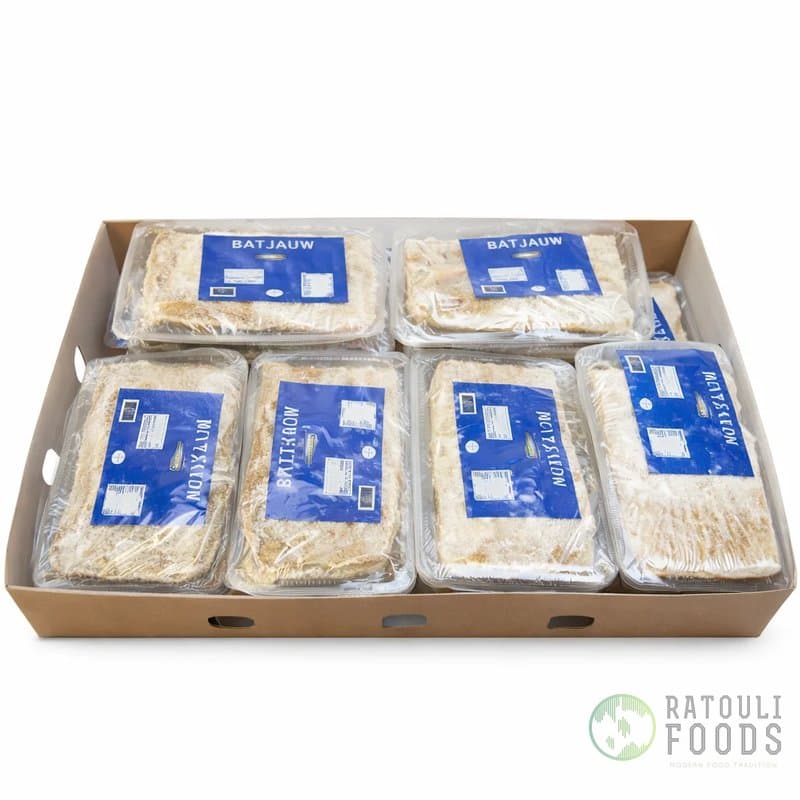
Saithe and Atlantic pollock are the same fish, Pollachius virens, the dark-fleshed species behind most bakkeljauw. Pollack, Pollachius pollachius, is a different fish with paler golden flesh. So saithe vs pollock is not a real fight. Saithe vs pollack is. Read the Latin name on the spec, not the marketing label.
The one line on the spec sheet that decides everything
I trade salted white fish for a living, and the priciest mistake I watch buyers make is treating saithe, pollock and pollack as three words for the same thing. They are not. Two of them are one fish. The third is a different animal at a different price.
Here is the rule. Saithe and Atlantic pollock both mean Pollachius virens. Same species, two names for two markets. The UK calls it coley or coalfish, the Dutch koolvis, the US Atlantic pollock. Raw, the flesh is grey-pink. Cooked, it goes off-white. This is the fish that has carried most diaspora-trade bakkeljauw for decades.
Pollack is Pollachius pollachius. Different species. The UK trade also calls it lythe. The flesh runs paler and more golden, it carries a different price, and the bakkeljauw market is not built on it. The two English names sit one letter apart, which is exactly why offers get muddled. So when a sheet says "pollock" and you are pricing against "pollack", check the Latin. Saithe vs pollock is a non-issue once you know they are one fish. Saithe vs pollack is the one that moves money.
What fish is bakkeljauw, really
Bakkeljauw is salted, traditionally also dried, white fish. It is the Surinamese word for what plain Dutch calls klipvis, also rotsvis. You will see it written bakkeljouw, bakkaljauw, and batjauw. The word comes straight down from Portuguese bacalhau, through Spanish bacalao, which is why so much of the salted-fish world shares one root.
Now the part most recipe blogs get wrong. They write "gezouten kabeljauw", salted cod, Gadus morhua. Diaspora-trade bakkeljauw usually is not cod. After the Grand Banks cod stocks collapsed, the trade moved to cheaper species. The Dutch encyclopedia says it plainly. In Suriname, the Antilles and Central Africa, klipvis is made from saithe (koolvis, Pollachius virens, coley or coalfish in the UK), plus ling and tusk. Albert Heijn does not hide it either. Their Lufo product is labelled "Bakkeljauw filet Alaska pollock".
So what fish is bakkeljauw? Most of the time it is salted saithe or pollock, not salted cod. Heavy salting, around 20 to 22 percent, holds it for up to a year. That kept it edible on the long colonial voyages to Suriname, and it is still why the product travels and stores the way it does. Honest species naming is not a weakness here. It is what separates a serious supplier from one reselling a guess.
The name map across markets
The reason this gets confusing is that you are juggling two naming systems at once. One set of names is for the salted product. Another set is for the live species. A buyer in Paris, Lisbon and Rotterdam can be talking about the same fish in the same box and use three words that look unrelated.
Split it cleanly. "Bacalhau", "bacalao", "klipvis" and "saltfish" describe the salted format, whatever the species. "Saithe", "koolvis" and "coley" describe the actual fish, whatever the processing. Here is the map I work from:
| Category | Names you will see |
|---|---|
| Surinamese / Dutch cluster (the product) | bakkeljauw, bakkeljouw, bakkaljauw, batjauw, klipvis, rotsvis, bacalao |
| Generic saltfish / bacalao (the product) | bacalhau (PT), bacalao (ES), baccalà (IT), morue salée (FR), Klippfisch (DE), saltfish / salt cod (EN, Caribbean) |
| The saithe species itself, Pollachius virens | koolvis (NL), lieu noir / colin (FR), Seelachs / Köhler (DE), carbonero (ES), merluzzo nero (IT), escamudo (PT), coley / coalfish (UK), Atlantic pollock (US) |
| The other fish, Pollachius pollachius | pollack, lythe (UK) |
One legal footnote worth knowing. In Portugal, the word "bacalhau" is reserved by law for Gadus morhua. Saithe sold there has to go as escamudo or "tipo bacalhau", bacalhau-type. That is a useful tell. If a Portuguese-origin offer calls saithe "bacalhau" outright, someone is being loose with the label.
Why the distinction changes your cost and your cook
This is not pedantry. The species and the format on your spec drive both what you pay and what your customer does in the kitchen.
On format, three things are sold and they are not the same product:
- Filet, near-boneless, ready after desalting, the mass-retail default. Convenient, costs more.
- Split-and-salted on the bone, sold as "heel" (whole) and "moten" (chunks). Cheaper, but the cook has to shred and debone it. In Codex STAN 167 terms, "split" keeps the whole backbone, "fillet" removes fins and main bones.
- Migas, the small shredded boneless-skinless pieces, faces, wings, tails, thin loins. The economical format, heavily processed in China.
Whichever format you buy, the fish has to be desalted before eating or it is inedibly salty. Surinamese cooks call this uitkoken. Two ways. Boil 15 to 20 minutes in plenty of water, drain, taste, repeat until it is right. Or soak about 24 hours, changing the water every 3 to 4 hours. Then rinse cold, squeeze dry, flake, and pick out every bone. From there it goes into broodje bakkeljauw, heri heri, telo, moksi alesi or bakkeljauwballetjes.
On the B2B side, the numbers you confirm are moisture and water-phase salt. Moisture is cut to the destination market. 48 to 50 percent for Portugal, 51 percent for NL, Spain and the UK, 52 to 54 percent for the US, 54 percent for Brazil, with salt around 20 to 22 percent. Water-phase salt, WPS = %salt x 100 / (%salt + %moisture), is the HACCP control. At least 17 percent WPS allows ambient storage. Below that needs chilled. One thing catches people out. Heavily salted bakkeljauw still ships and stores chilled, not ambient. If a seller cannot give you moisture and WPS figures, you do not have a real spec yet. You have a hopeful one.
What to confirm before you buy, and what not to confuse it with
When an offer lands, I read four lines before anything else. The Latin name, so I know it is Pollachius virens and not something else. The format, filet, split on the bone, or migas. The moisture and salt percentage, cut to my market. And the cold-chain plus import paperwork.
On paperwork into the EU, you need approved-establishment sourcing, entry through a designated border control post, a GGB/CHED health document and NVWA registration. Pack norms run 350 to 600 g retail pouches, 5 kg bags and 2x5 kg (10 kg) boxes for horeca, 9 and 25 kg cartons, and full container loads at scale with an MOQ around 10 metric tons. China, mainly Qingdao and Shandong, is the dominant processing hub for salted pollock and cod fillet, migas and bits.
Last thing, and it trips up even experienced buyers. Keep these three apart:
- Bakkeljauw is salted saithe or pollock. Klipvis. The "Surinaamse stokvis" label you sometimes see is wrong, because bakkeljauw is salted, not unsalted.
- Stockfish (stokvis, Stockfisch, stoccafisso, okporoko, panla) is unsalted, air-dried. Never a bakkeljauw synonym.
- Makayabu is salted saithe or pollock, split with the backbone in, usually unwashed with heavy surface salt, a Central African staple. We sell it as its own SKU, not as bakkeljauw.
Get the Latin name, the format and the salt figures right and the rest of the deal is straightforward. Get the saithe vs pollack distinction wrong and you are paying for one fish while expecting another. If you want me to read an offer you have on the table, send it over and I will tell you what you are actually buying.
Talk volume and price
Book a 15-minute call or send your spec. You deal with the production planner direct, not a call centre.