Fillet vs split-salted on the bone: yield, price and which your customers want
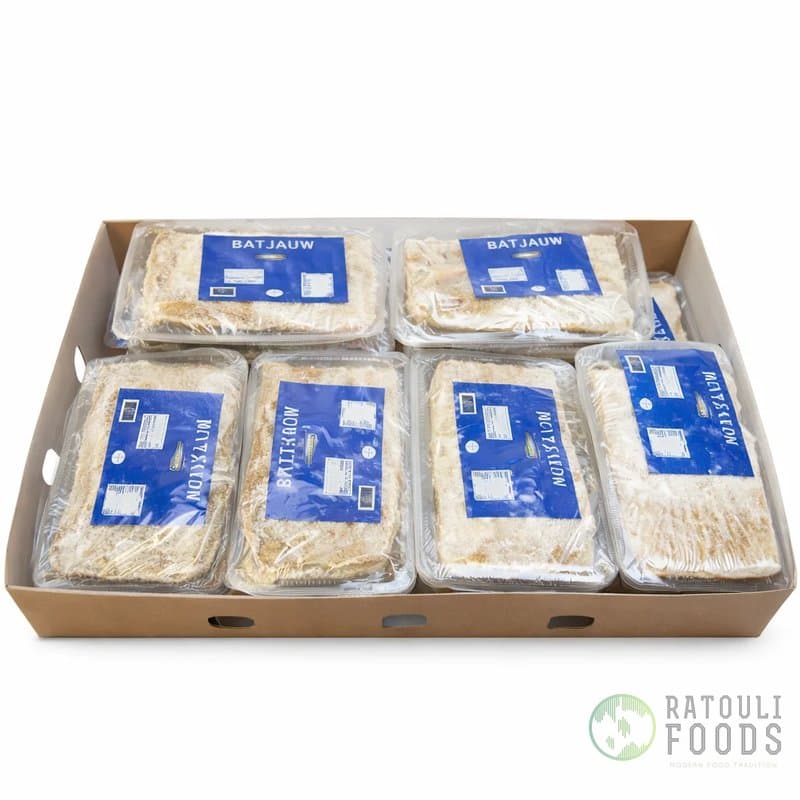
Fillet bakkeljauw costs more per kilo but lands more edible fish on the plate, near-boneless and ready after desalting, which is why retail defaults to it. Split-salted on the bone, sold as heel or moten, is cheaper but loses weight to bone and skin and asks the cook to shred and debone it.
Two forms, one fish
Bakkeljauw is salted white fish, usually saithe or pollock, not the classic Gadus morhua cod most recipe blogs still name. It arrives in two forms that matter to a buyer, and the difference is not flavour. It is bone, labour and yield.
Fillet (filet, zonder of met weinig graten) is near-boneless. The fins and main bones are off, the fish is desalted after uitkoken and ready to flake. It costs more per kilo, and it sells itself off the retail shelf because the shopper does nothing but soak and cook.
Split-salted on the bone keeps the whole backbone in. It comes as heel, the whole split fish, or moten, chunks and portions. It is cheaper per kilo at landing, and that gap is real. But the cook pays it back at the stove: shred the fish, pull the backbone, pick out every small bone before it goes near a pan.
So the salt fish fillet vs split question is really a labour question dressed up as a price question. Who does the deboning, you, your packer, or the end customer, and what is that worth in the channel you sell into.
What Codex STAN 167 actually says
The names are not loose marketing. Codex STAN 167, the international standard for salted and dried salted fish, defines the cuts. Use them straight when you write a spec or a label.
Under the standard, split fish is opened along the belly and flattened with the whole backbone left in, or most of it. Salt-fillet removes the fins and the main bones. That one line is the whole commercial story. Split keeps the backbone, fillet takes it out. The yield, the price, the buyer all follow from that single cut.
Migas sit below both. They are the small shredded boneless-skinless pieces, faces, wings, tails and thin loins, the economical format, heavily processed in China. Migas are not a fillet and not a split fish. They are offcuts sold honestly as offcuts, and they have their own buyer who wants flake and price, not presentation.
If you spec on the bone, say heel or moten and reference split. If you spec near-boneless, say filet. Mixing the words on a packing list is where claims and reality drift apart, and that is the kind of thing that costs you a buyer.
Yield and price, side by side
Here is the comparison a packer cares about. Numbers move with supplier, moisture target and how hard a fish is trimmed, so treat these as working ranges, not guarantees.
| Factor | Fillet (filet) | Split-salted on the bone (heel / moten) |
|---|---|---|
| Codex STAN 167 cut | Fins and main bones removed | Whole backbone kept in |
| Bone in product | Near-boneless, few small bones | Full backbone plus rib bones |
| Edible yield after deboning | High, little waste | Lower, weight lost to bone and skin |
| Price per kilo at landing | Higher | Lower |
| Labour at the stove | Soak, cook, flake | Soak, cook, shred, pull backbone, pick bones |
| Retail fit | Default, pouch 350 to 600 g | Niche, sold to cooks who want the price |
| Horeca / volume fit | Good, predictable portioning | Good where kitchen labour is cheap |
| Typical buyer | Supermarket shopper, busy household | Traditional cook, value buyer, some diaspora |
The split salted fish yield is the line that catches people out. The kilo is cheaper, but a chunk of it is backbone and skin you throw away. Net out the bone and the extra kitchen time and the fillet often wins on cost per usable portion, even at the higher shelf price. Run the maths on edible grams, not on the bag.
Which diaspora buys which
The Netherlands is the primary market. About 365,000 people of Surinamese descent live here, the largest Caribbean community in Europe, roughly 37 percent of all Surinamese worldwide, with Almere holding the highest share. That is the core bakkeljauw buyer, and the split runs by habit and by dish.
The convenience buyer wants fillet. Younger households, anyone making broodje bakkeljauw on a weekday, the supermarket shopper reaching for a pouch off the shelf. Albert Heijn already sells Lufo Bakkeljauw filet on Alaska pollock, which tells you where retail volume sits. Bakkeljauw filet wholesale moves to packers feeding exactly that shelf.
The traditional cook will still take it on the bone. Some older Surinamese kitchens hold that the bone-in fish has more character, and for a slow dish like heri heri, the symbol meal of Keti Koti on July 1, the extra handling is part of the cooking. Telo with bakkeljauw, the Surinamese fish and chips, goes either way.
Adjacent buyers shift the picture. Lusophone customers buying bacalhau lean to larger split sides for Christmas. Central African makayabu eaters want split with the backbone in and heavy surface salt, but note that makayabu is the same salted saithe or pollock sold as its own SKU, cured harder, not a bakkeljauw fillet under another name. Know which buyer you are quoting before you pick the form. If the Surinamese shelf is your market, the Bakkeljauw wholesale page covers the forms and specs.
How to spec your order
A few things keep an order clean. First, name the form in Codex language. Filet for near-boneless, split with heel or moten for on the bone, migas for shredded offcuts. Do not let a packing list say one and ship the other.
Second, hold the species honest. Most diaspora-trade bakkeljauw is saithe or pollock, not cod, and saying so is an authority lever, not a weakness. Watch the pollock trap: the bakkeljauw fish is Pollachius virens, saithe or coley, not Pollachius pollachius, the separate pollack. If the label says cod, ask for the Latin name.
Third, match moisture to your market. NL and Spain run about 51 percent, Portugal 48 to 50, the US 52 to 54, with salt around 20 to 22 percent. Water-phase salt is your HACCP control, WPS = %salt x 100 / (%salt + %moisture), and you want at least 17 percent. Even heavily salted bakkeljauw ships and stores chilled, not ambient.
Fourth, size the pack to the channel. Retail wants 350 to 600 g pouches. Horeca takes 5 kg bags and 2x5 kg boxes. Container scale runs 9 or 25 kg cartons, 20 or 40 foot FCL, MOQ around 10 metric tons. EU import needs approved-establishment sourcing, a designated border control post, a GGB/CHED health document and NVWA registration. Want a sample spec on either form? Mail us at Ratouli Seafood in Volendam and we will quote both, so you can run the yield yourself.
Talk volume and price
Book a 15-minute call or send your spec. You deal with the production planner direct, not a call centre.